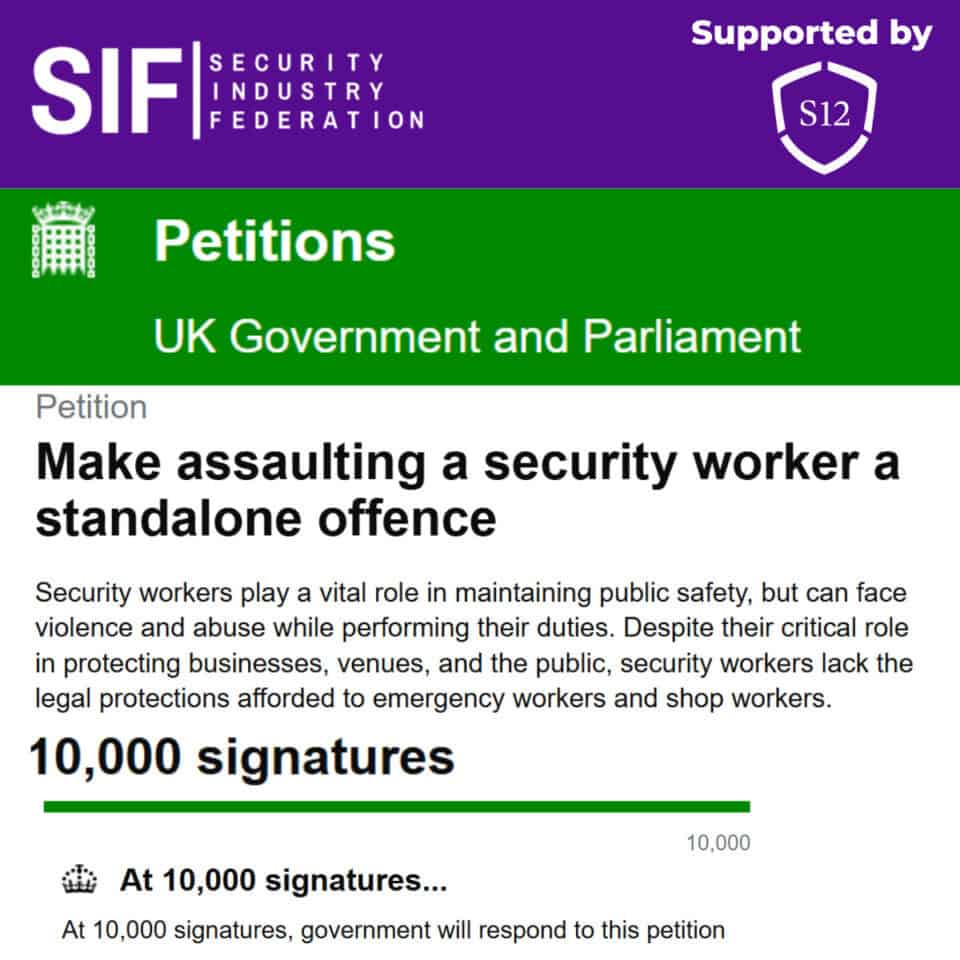
The SIF’s petition received the following response from the UK Government for reaching 10,000 signatures.
The SIF will make an official comment in due course.
Dear Daniel Garnham,
The Government has responded to your petition – “Make assaulting a security worker a standalone offence”.
Government responded:
There is existing legislation that provides protections to certain categories of security workers. The Home Office will work with stakeholders to consider this matter further.
The private security industry plays a crucial role in keeping the public safe.
Physical assaults and verbal abuse against security personnel are unacceptable. The Government recognises the vital work of the private security industry in protecting the public and safeguarding vulnerable people.
There is existing legislation that provides protection for some categories of security workers and this legislation will need to be considered in the context of this petition
We are aware that there have been previous calls for security workers to be included in the Assaults on Emergency Workers (Offences) Act 2018, which came into force on 13 November 2018. The categories included in that Act broadly cover police, prison officers, fire and rescue personnel and certain NHS workers who interact with the public as part of their work. These occupations and positions have been included in the legislation as they are individuals who may be required, at some point, to deal with emergencies and have been exposed to the risks of assault in the course of their day-to-day work as they perform the function of an emergency worker no matter whether they are on duty or not.
Where an assault occurs, there is a currently a wide range of offences that cover an assault against any worker, including security/door staff, which include offences such as common assault, actual bodily harm, grievous bodily harm, and other public order offences.
Section 156 of the Police, Crime, Sentencing and Courts Act 2022 created a statutory aggravating factor in sentencing cases of assault against public-facing workers. It applies where an assault is committed against those providing a public service, performing a public duty or providing a service to the public, including public-facing roles in banks and building societies. This reinforces the seriousness with which the courts treat offences against anyone providing a public service. In effect, a person convicted of an assault against any worker providing a public service could see their sentence increased within the current maximum penalty for the offence under which they are convicted.
Furthermore, through the Home Office’s Crime and Policing Bill, which was introduced in the House of Commons in February 2025, this Government has introduced a new specific standalone offence of assaulting a retail worker to help tackle the epidemic of shop theft and violence towards shop workers. This includes security staff, either directly employed by the retailer or employed by a third-party on behalf of the retailer.
For the purposes of this new offence, the Home Office’s definition of a ‘retail worker’ is intentionally narrow given the vital need to provide legal clarity and ensure there is no ambiguity for courts in identifying whether an individual is a retail worker, and the assault took place in the course of their work.
Those workers whose roles are not included within the definition are already covered under other legislation such as the Offences against the Person Act 1861, which also covers more serious violence, such as actual bodily harm and grievous bodily harm.
In this legislative context, work would need to be conducted by the Home Office to understand what the elements of any potential ‘new’ offence would include that is not already covered by existing legislation. The Home Office will work with stakeholders to hear views and consider this matter further.
Home Office
Click this link to view the response online:
https://petition.parliament.uk/petitions/750121?reveal_response=yes
The Petitions Committee will take a look at this petition and its response. They can press the government for action and gather evidence. If this petition reaches 100,000 signatures, the Committee will consider it for a debate.
The Committee is made up of 11 MPs, from political parties in government and in opposition. It is entirely independent of the Government. Find out more about the Committee: https://petition.parliament.uk/help#petitions-committee
Thanks,
The Petitions Team
House of Commons